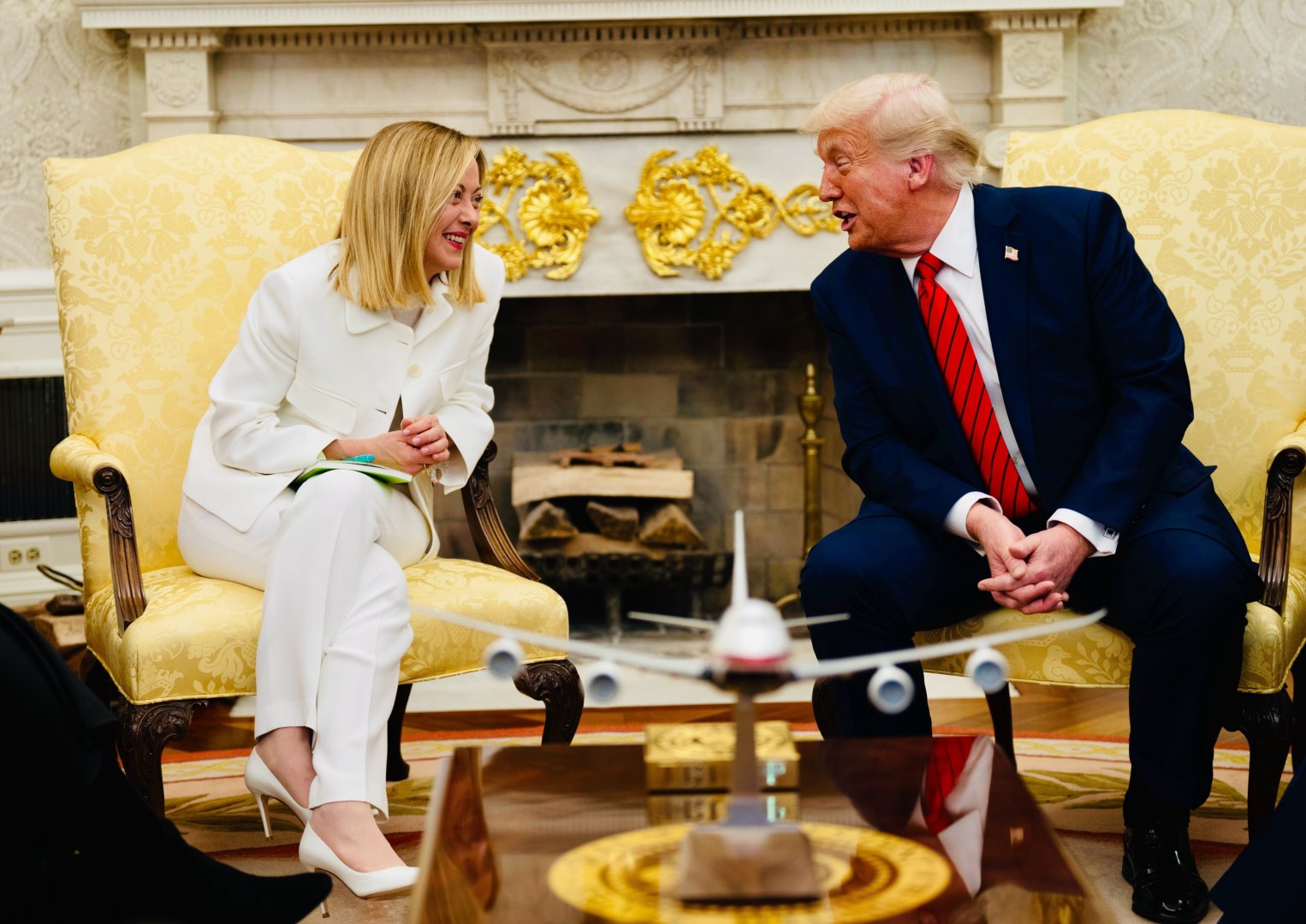
While Europe faces its most serious security crisis since 1945, a leader who proclaims herself Atlanticist and Europeanist cultivates a strategic alliance with those who want to dismantle the Union and normalize the Russian aggressor. This is the Meloni paradox: she doesn't betray with explicit acts, but with choices that objectively serve Vladimir Putin's interests.
The Paradox of the Atlanticist Premier
In January 2025, while Russian bombs continued to fall on Ukrainian cities, Giorgia Meloni appeared at Mar-a-Lago to meet Donald Trump. Photographs of the meeting showed smiles and handshakes, the rhetoric spoke of a 'renewed transatlantic partnership'. But behind the diplomatic facade lay an uncomfortable truth: the Italian premier was consolidating an alliance with the only Western leader openly aligned with Vladimir Putin.
This is not a moral judgment but a geopolitical analysis based on documented facts. Meloni has never expressed explicit support for Russia. She voted for sanctions, sent weapons to Kiev, hosted Zelenskyy in Rome. Yet her choice to strategically align with Trump — a president who has withdrawn military assistance from Ukraine, normalized relations with Moscow, and described Europe as an adversary — places her in a position of indirect collaborationism with the Kremlin.
The mechanism is insidious precisely because it requires neither direct coordination nor malicious intent. It is enough to share the same 'ideological ground' with actors serving Russian interests for one's actions, however apparently autonomous, to end up reinforcing Moscow's strategic objectives: fragmenting the European Union, weakening NATO, legitimizing the use of force to redraw borders.
Trump and Putin: A Documented Alignment
The perception of Donald Trump as a pro-Putin actor rests not on conjecture but on a documented sequence of political actions dating back to 2016. The investigation by Special Counsel Robert Mueller established unequivocally that the Russian government implemented a systematic operation of electoral interference to favor Trump's candidacy, including information manipulation conducted by the Internet Research Agency and hacking operations against the Democratic Party.
The Mueller Report: Established Connections
The Mueller Report detailed numerous links between the Russian government and the Trump campaign. Among the most relevant facts:
- The 'Trump Tower Moscow' project, pursued by Michael Cohen on behalf of Trump between 2015 and 2016 while the latter was a presidential candidate, creating a potential dependency link to the Kremlin during the critical phase of American leader selection
- The Trump Tower meeting on June 9, 2016 between Paul Manafort, Donald Trump Jr., Jared Kushner, and Russian citizens, after Trump Jr. was informed that the Russians possessed compromising information on Hillary Clinton provided by the Russian government
- The systematic lies of Trump's associates (Flynn, Papadopoulos, Gates, Cohen) to federal investigators regarding their contacts with Russians, with 37 indictments and 7 guilty pleas
- The Helsinki summit of 2018, where Trump publicly accepted Putin's denials about electoral interference, disavowing the conclusions of his own intelligence agencies
2025: The Institutionalization of Pro-Putinism
With Trump's return to the White House in 2025, the posture of closeness to Moscow transformed from isolated acts into structured foreign policy. On February 12, 2025, Trump held a 90-minute phone call with Putin to initiate direct negotiations on ending the war in Ukraine, excluding European allies and Ukrainian leadership from decision-making processes. This call preceded by hours the phone call with Zelenskyy, to whom Trump effectively imposed terms already agreed with the Kremlin.
The Russian reaction was jubilant. Dmitry Peskov and Alexei Pushkov praised the new administration's position as 'much more attractive', while Russian state media headlined that Trump had 'signed Zelenskyy's death sentence'. On February 19, Trump openly accused Kiev of having started the war and pressured Zelenskyy to hold elections under martial law, echoing one of Moscow's key demands.
| Date | Event | Trump Action |
|---|---|---|
| Feb 12, 2025 | Trump-Putin Call | Bilateral agreement for negotiations excluding EU |
| Feb 19, 2025 | Attack on Zelenskyy | Trump calls Ukrainian leader a "dictator" |
| Feb 24, 2025 | UN Vote | USA votes against condemnation of Russian invasion |
| Mar 1, 2025 | Cyber Policy Shift | Russia no longer considered cyber threat |
| Mar 3-5, 2025 | Aid Freeze | Suspension of military assistance and intelligence sharing |
The National Security Strategy 2025: Europe as Enemy
The most significant document demonstrating Trump's pro-Russian reorientation is the National Security Strategy released in December 2025. This 33-page document marks a dramatic break with the 2017 strategy and with American foreign policy of the past seventy years. The NSS 2025 does not identify Russia as an adversary or threat, but speaks of achieving 'strategic stability' with Moscow.
The 'Civilization Cancellation' Narrative
While Russia is treated with deference, the European Union and its liberal governments are described as the real adversaries. The section 'Promoting European Greatness' accuses Europe of facing the 'prospect of civilization cancellation' due to migration policies. The document explicitly adopts the language of the 'Great Replacement', suggesting that within a few decades some NATO members will become 'non-European majority'.
This rhetoric is not merely descriptive but prescriptive. The strategy calls on the United States to 'cultivate resistance' within European nations against their own governments, described as 'unstable minority governments' that trample democratic principles to suppress patriotic opposition. This is direct interference in the sovereignty of European allies, orchestrated by a White House that sees far-right parties as its only legitimate interlocutors.
The reception of this document in Moscow was positive. Kremlin spokesman Peskov stated that the strategy is 'broadly consistent' with Russia's worldview. In contrast, the German Chancellor called elements of the strategy 'unacceptable', while Antonio Costa accused Washington of launching a 'threat to interfere in European politics'.
Meloni in the MAGA Orbit: Ideological Synchrony
In this scenario of transatlantic fragmentation, Giorgia Meloni's position assumes fundamental geopolitical relevance. The premier has sought to play the role of the 'pragmatic radical', attempting to balance formal loyalty to the EU and NATO with a deep ideological affinity for the MAGA movement. But this 'balancing' strategy conceals profound risks.
From CPAC to Mar-a-Lago
Meloni's participation in American conservative forums like CPAC and her meeting at Mar-a-Lago in January 2025 demonstrate a willingness to establish herself as Trump's privileged interlocutor in Europe. In her CPAC speech, Meloni echoed Trumpian narratives about protecting Western values against a 'radical left' that would cancel national identity.
Although she continued to speak about the need for a 'just peace' in Ukraine, her refusal to openly criticize Trump's disengagement and her decision to praise the American 'change of pace' toward Russia — despite this change of pace being effectively a surrender to Kremlin demands — indicate political submission to MAGA leadership.
The danger lies in the fact that the Russian narrative of 'culture war' is the main tool used by the Kremlin to divide Western democracies. By adopting this language, Meloni weakens the European cohesion necessary to counter the Russian hybrid threat. Analysts at the European Council on Foreign Relations have noted that the Italian political environment remains 'fertile ground for Russian influence', with leaders not hesitating to suggest withdrawing military support from Ukraine in the name of a 'peace' that follows Moscow's wishes.
The Lega's Formal Ties to the Kremlin
If for Meloni collaborationism may appear as an indirect consequence of her political strategy, for her main government ally, Matteo Salvini, ties to Russia are explicit and documented. The agreement between Lega and Putin's party, 'United Russia', signed in 2017 and automatically renewed in 2022 shortly after the invasion of Ukraine, remains a channel of direct influence never formally interrupted.
The 'Metropol' Investigation
This connection fits within the context of the 'Metropol' investigation, which revealed a negotiation in Moscow in 2018 to finance Lega with proceeds from a Russian oil deal. Recent investigations have identified among the Russian participants Andrey Kharchenko, an officer of the FSB's Fifth Service, the Russian unit tasked with destabilizing foreign democracies and interfering in foreign politics.
Kharchenko, protector of fascist philosopher Aleksandr Dugin, acted as a bridge between the Kremlin and European populist movements. Copasir highlighted how this network of influence activates at key moments of parliamentary debate, promoting narratives that blame Western sanctions for rising energy prices, exactly as suggested by Kremlin propaganda documents.
When Meloni decides to ignore these dynamics or not to impose on her deputy prime minister a formal break with United Russia, she effectively accepts coexistence with Russian influence agents within her own government coalition. This aspect is not negligible: it clearly shows that rhetorical distance from Russia does not translate into real operational change.
Indirect Collaborationism: Mechanisms and Consequences
To understand why sharing Trump's positions entails indirect collaborationism toward Putin, it is necessary to analyze the nature of 'Grey Zone Warfare'. Russian strategy does not necessarily aim at territorial conquest of Europe, but at its Finlandization and fragmentation. In this framework, every action that weakens multilateral institutions (EU and NATO) serves Moscow's interests.
The Three Vectors of Collaborationism
Indirect collaborationism manifests in three main ways:
- Validation of circumventing narratives: When Trump or his European allies blame Zelenskyy for the war or describe the Russian invasion as a legitimate reaction to NATO expansion, they provide moral and political cover for Putin's aggression
- Erosion of collective defense: The threat to withdraw NATO support or to let Russia do 'whatever it wants' to delinquent members destroys Article 5 deterrence, encouraging Putin to test the alliance's boundaries
- Internal destabilization via Proxy: The NSS 2025 invites the USA to intervene in European internal politics to support far-right parties against incumbent governments, creating permanent instability that diverts resources from defense against Russia
Direct coordination between Trump, Putin, and Meloni is not necessary to produce aligned results. It is sufficient that they share the same 'common ideological ground' — centered on fighting globalism and liberalism — for their actions to reinforce each other in a positive feedback loop for the Kremlin.
The European Union as Collateral Victim
The consequences of this alignment are already visible and threaten to become irreversible. The reduction of American presence in Europe, invoked by the NSS 2025, leaves Europe vulnerable not only militarily but also economically. If 'Trump's peace' were to materialize according to terms discussed with Putin, Ukraine would cease to be a vital sovereign state.
Ukrainian Collapse and Migration Crisis
Freezing the conflict without security guarantees would lead to economic and social collapse of Kiev, with the risk of an exodus of tens of millions of refugees toward Western Europe. This scenario would further fuel the narrative of 'civilization cancellation' and migration crisis on which Trump and his European allies build their consensus, creating a vicious cycle of instability that benefits only Moscow.
Italy's Loss of Strategic Relevance
For Italy, aligning with Trump and accepting the Russian sphere of influence would reduce its strategic relevance and increase vulnerability in the Enlarged Mediterranean according to the NSS 2025. Russia, through its proxies in Africa and its presence in Libya and Syria, already controls migration routes and energy resources fundamental to Rome.
Without the support of a united Europe and a solid transatlantic alliance that sees Russia as a threat to contain, Italy is destined to become a satellite of external powers, despite the rhetoric of 'national sovereignty'. The paradox is that by invoking national sovereignty in an anti-European key, Meloni ends up delivering Italy to an even deeper dependence on external actors.
Conclusions: The Choice Italy Cannot Avoid
The analysis of facts presented demonstrates that Donald Trump acts as the main facilitator of Russian geostrategic interests within the Western system. His conduct from 2016 to 2025, culminating in the National Security Strategy 2025 and the withdrawal of support from Ukraine, configures a pro-Putin position that aims at the destruction of the European Union and the marginalization of NATO.
In this context, Giorgia Meloni's choice to share Trump's positions and to maintain within her government parties formally linked to the Kremlin cannot be interpreted as a simple tactical choice. It is a form of indirect collaborationism that provides Putin with political tools to divide the West.
Although Meloni may be motivated by sincere ideological affinity or the desire to guarantee Italy a privileged place alongside the new MAGA superpower, the objective consequences of her actions are the weakening of European security and the legitimization of Russian aggression. Indirect collaborationism is insidious precisely because it does not require full awareness: it is enough to serve the same objectives as the enemy to become, in effect, an ally.
The challenge for Europe and for Italian democratic institutions will be to recognize this dynamic before misalignment becomes irreversible. Resilience against Russian hybrid threats requires a cohesion that Trump's posture and Meloni's closeness deliberately call into question. The European Union is not just a bureaucratic institution or a common market: it is the bastion of democracy, rule of law, and collective security that has guaranteed peace and prosperity for seventy years.
Without a clear reversal of course and a reaffirmation of the centrality of liberal-democratic values and European integration, Italy risks slipping toward a gray zone of influence, inadvertently contributing to the success of Vladimir Putin's plan for a new post-Western world order. History will judge those who chose the comfortable illusion of alliance with the strong of the moment, betraying the patient construction of a united Europe that represents the only credible bulwark against the authoritarianism of the 21st century.
Sources
Mueller Special Counsel Investigation
- Robert Mueller, 'Report On The Investigation Into Russian Interference In The 2016 Presidential Election', U.S. Department of Justice, 2019
- American Bar Association, 'Mueller finds no collusion with Russia, leaves obstruction question open', 2019
- CSIS, 'Russian Meddling in the United States: The Historical Context of the Mueller Report', 2019
Trump Administration 2025 and Russia Policy
- The Guardian, 'How Trump is driving US towards Russia – a timeline', 2025
- PBS News, 'Russian officials rejoice after Trump ditches 3 years of U.S. policy on Ukraine', 2025
- Yahoo News Canada, 'Trump Backs Off Promise to Sanction Russia for Ukraine War', 2025
- The Guardian, 'Ukraine war briefing: Shock as Trump aid freeze hits Ukrainian causes', 2025
National Security Strategy 2025
- TIME Magazine, 'Trump's National Security Strategy Sparks European Backlash', 2025
- Modern Diplomacy, 'Decoding Trump's America First Doctrine: What his National Security Strategy Revealed', 2025
- Providence Magazine, 'Trump's National Security Strategy Delivers a Troubling Message to Europe', 2025
- The Parliament Magazine, 'Trump's foreign policy seeks to undermine the EU — and strengthen Europe's nationalists', 2025
- Post Alley, 'Trump's New National Security Strategy: Europe's Crap, NATO's Weak', 2025
Meloni and the Relationship with Trump
- The Conservative, 'Meloni's Speech at CPAC: Let's Defend Western Values', 2025
- Ukrainska Pravda, 'Italy's PM praises Trump's tougher stance on Russia amid Ukraine war', 2025
- IAI Istituto Affari Internazionali, 'Giorgia Meloni's Italy between Trump and Europe', 2025
- Georgetown Journal of International Affairs, 'Giorgia Meloni's Strategic Balancing Act', 2025
- European Interest, 'AfD, Marine Le Pen and other patriots ready to align with Trump and Putin', 2024
Lega and Ties to Russia
- Il Foglio, 'What the agreement (renewed in 2022) that unites Salvini's party and Putin's says', 2022
- Open, 'Matteo Salvini and the pact with United Russia: The agreement between Lega and Putin never dissolved', 2022
- Radicali.it, 'The text of the agreement between Lega and United Russia', 2017
- The Black Sea, 'Plot to Channel Millions from Russia to Italy's Ruling Lega Party', 2019
- The Insider, 'How the FSB tried to buy an Italian political party', 2019
- The Guardian, 'Italian prosecutors investigate League over alleged Russian oil deal claims', 2019
Strategic Analysis and Security
- ECFR, 'Democratic defence: How Italy can lead the fight against Russian disinformation', 2024
- ECFR, 'Reality show: Why Europe must not cave in Trump's culture war', 2025
- Atlantic Council, 'Experts react: What Trump's National Security Strategy means for US foreign policy', 2025
- Safety & Security Magazine, '2025 Report on National Security: a world of growing instability', 2025
- Confindustria, 'SISTEMA ITALIA 2025', 2025