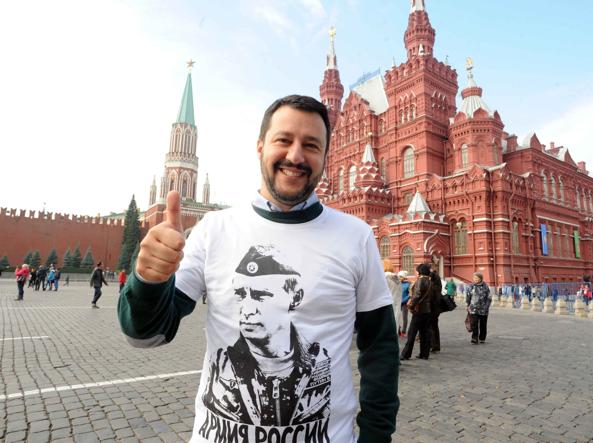
A documented analysis reveals how two of Italy's main political forces, Matteo Salvini's Lega and the Five Star Movement, have acted as multipliers of Russian propaganda through formal agreements never rescinded, systematic rhetorical convergences, and parliamentary behavior that has repeatedly favored Kremlin interests. From the rooms of the Hotel Metropol to opposing votes in the European Parliament, a network of behaviors that raises questions about Italian decision-making sovereignty.
Italy's Vulnerability to Russian Influence
Italy has historically been defined as the European Union's "vulnerable front" facing Russian influence campaigns. A condition that didn't emerge today but has its roots in a complex stratification of economic, political, and cultural ties dating back to the Cold War. With the fall of the Soviet Union, this legacy didn't dissolve but transformed, finding new vectors in populist and sovereignist forces that identified Vladimir Putin's Russia as a model of resistance against the global liberal order.
Energy dependency provided additional leverage: before 2022, 40% of Italian gas came from Russia. This interdependence fueled the narrative that Western sanctions would damage the European economy more than they would hurt Moscow. An argument systematically adopted by both Lega and the Five Star Movement to justify demands for easing restrictive measures.
In this context, Matteo Salvini's Lega and the Five Star Movement emerged as the main vectors of a geopolitical posture that, while oscillating between institutionalism and populism, has presented systematic points of contact with the Kremlin's strategic narrative.
The Agreement That Won't Be Rescinded: Lega and United Russia
On March 6, 2017, in Moscow, Lega and United Russia (Edinaya Rossiya), Vladimir Putin's party, signed a cooperation agreement. Not a simple memorandum of understanding, but a detailed action plan providing for regular exchange of information and delegations at various levels, promotion of regional contacts, and cooperation in key sectors such as the economy and "youth education in the spirit of patriotism."
The most critical aspect of this agreement is its temporal persistence. Signed for five years with automatic renewal absent formal denunciation, the treaty was renewed on March 6, 2022, just days after the invasion of Ukraine and the bombing of Kiev. Despite Russian aggression, Lega has never formally terminated the pact.
Although Lega representatives have attempted to minimize it by calling the agreement "waste paper," the absence of an official act of rupture signals a willingness to keep a political channel open with Putin's regime, negatively influencing the perception of Italy's reliability among Euro-Atlantic partners.
Agreement Contents: A Parallel Channel to the State
Analysis of the clauses reveals the creation of a true parallel diplomatic channel to that of the Italian State:
- Exchange of delegations: Organization of regular meetings at various institutional levels, creating diplomatic channels parallel to those of the State
- Economic cooperation: Promotion of bilateral investments and trade, using business as a pressure tool against sanctions
- Youth training: Education in "the spirit of patriotism and industriousness," convergence on the Kremlin's conservative and identitarian values
- Duration and automatic renewal: Valid for 5 years with automatic renewal if not denounced, ensuring the permanence of the political bond even during the war in Ukraine
The Metropol Case: 65 Million Dollars for European Elections
In October 2018, at the Hotel Metropol in Moscow, a meeting took place that would shake Italian politics. Gianluca Savoini, close collaborator of Salvini and president of the Lombardy-Russia Association, participated in an oil negotiation aimed at secretly financing Lega with approximately 65 million dollars ahead of the 2019 European elections.
Despite the judicial archiving in 2023, motivated by the impossibility of proving actual money transfers, audio recordings of the meeting confirmed the existence of intense dialogue between party sectors and Russian apparatus on issues of strategic interest.
Salvini's behavior during the investigation was characterized by systematic reticence: the Lega leader avoided reporting to Parliament, leaving Prime Minister Giuseppe Conte to explain the government's position, and continued to maintain relations with Savoini despite serious institutional embarrassment.
M5S: From Anti-Atlanticism to Instrumental Pacifism
The Five Star Movement followed a path of rapprochement with Russia rooted in the movement's original phase, characterized by strong criticism of supranational institutions and NATO. Between 2014 and 2016, figures like Manlio Di Stefano actively promoted the Russian version of events regarding Euromaidan.
The Demonization of Ukraine
Di Stefano publicly defined the pro-European protests as a Western-financed "coup d'état" and accused the Ukrainian government of being led by "neo-Nazis." This terminology, identical to that used by the Kremlin to justify the special military operation, was accompanied by demands to immediately abolish sanctions against Russia.
The affinity was reaffirmed by Five Star delegations' participation in the United Russia congress in 2016, sanctioning an ideological harmony based on shared rejection of American interventionism and European centralism.
Conte's Turn: Pacifism as a Weapon
With the 2022 invasion, M5S initially supported arms shipments under the Draghi government but quickly reversed course once in opposition. Giuseppe Conte's new line focused on criticism of the "military-industrial complex" and denouncing the risk of nuclear escalation.
Conte adopted rhetoric placing the aggressor's responsibilities on par with those of the West, suggesting that the continuation of the conflict was fueled by Washington's will to weaken Russia at European citizens' expense. This positioning led to the break with Luigi Di Maio, who left the movement accusing Conte of endangering national security.
Rhetorical Convergences with Kremlin Propaganda
Analysis of Lega and M5S public statements reveals systematic convergence with key themes of Russian communicative strategy during the war in Ukraine.
The Myth of Negotiation as Surrender
Both Salvini and Conte have repeatedly called for cessation of arms shipments as a precondition for a negotiating table, ignoring that Russia has never shown genuine willingness for dialogue that didn't include Ukraine's capitulation. This position perfectly coincides with Moscow's strategic objective of interrupting Western supplies to consolidate territorial conquests.
The insistence on immediate negotiation is accompanied by delegitimization of Ukrainian resistance, presented as an obstacle to global economic stability. The narrative that Ukraine would be a "failed state" or "US puppet" emerges indirectly through speeches emphasizing the ineffectiveness of military aid.
Delegitimization of Sanctions
Lega has systematically questioned the effectiveness of sanctions, claiming they are driving Italy into recession while Russia remains unscathed. This analysis, often based on manipulated data from the Russian Central Bank, aims to crack European cohesion by leveraging voter concerns about the cost of living.
Particularly serious was Salvini's statement about the regularity of the 2024 Russian elections: "When a people votes, they are always right." A statement that ignored international denunciations of fraud, intimidation, and absence of real competitors, acting as an external legitimizer of a sham electoral process.
Parliamentary Behavior: Votes and Obstruction
Beyond rhetoric, political facts manifest through legislative activity. The behavior of Lega and M5S in the Italian Parliament and European Parliament reveals a strategy of obstruction or open opposition to the most incisive measures supporting Ukraine.
Italian Parliament: M5S Against Arms
In the national context, M5S distinguished itself through systematic opposing votes to decrees authorizing military supplies to Kiev. Lega, while part of the government majority officially supporting Ukraine, showed signs of internal discontent, with members expressing reservations about using Italian weapons on Russian territory.
European Parliament: Russia as "State Sponsor of Terrorism"
It is in Brussels that divergences become more evident. One of the most significant votes concerns the November 23, 2022 resolution declaring Russia a "State sponsor of terrorism."
- Five Star Movement: The entire delegation abstained, justifying the choice with fear that the label would close diplomatic channels
- Lega: The delegation voted inconsistently, with several parliamentarians voting against or abstaining, aligning with European far-right groups known for Kremlin ties
Another relevant example is the vote on supplying Taurus missiles to Ukraine (2025), where Lega and M5S found themselves united in voting against, echoing Russian fears of Ukrainian force projection striking strategic targets within the Federation.
The Disinformation Ecosystem and Hybrid Operations
Italy has been the target of a coordinated Russian strategy fusing political influence, propaganda, and digital operations. This ecosystem acts to maximize the impact of narratives favorable to Moscow, exploiting local political actors as repeaters.
The Troll Factory and Telegram
The Kremlin maintains a "troll factory" in St. Petersburg that has orchestrated targeted campaigns against Italian institutional figures, such as President Mattarella (whose impeachment was demanded via social media in 2018) or Minister Di Maio after his pro-Ukraine positioning.
Telegram has become the main refuge for this ecosystem. In Italy, thousands of channels share content produced directly by Russian outlets like RT or Sputnik, bypassing EU-imposed blocks. These spaces are characterized by high circulation of polarizing messages describing Italy as a "servant" of the United States and Russia as "liberator" of Donbas.
"From Russia with Love": Medical Soft Power
A masterful example of hybrid operation was the Russian medical mission sent to Italy in March 2020 during the first wave of COVID-19. Presented as an act of solidarity, it included military personnel expert in bacteriological warfare and was accompanied by massive media coverage aimed at demonstrating that, while the EU abandoned Italy, Russia came to the rescue.
Despite doubts about the actual usefulness of materials (obsolete ventilators and unsuitable disinfectants), the operation achieved enormous success in improving Russia's image with Italian public opinion. Lega and M5S actively promoted this "benevolent" image of Russia, using the episode to criticize the lack of European solidarity.
Implications for National Security and Italian Credibility
The convergence between Lega and M5S positions and Russian interests is not just a topic of political debate but represents a concrete challenge to national security and Western alliance cohesion.
Erosion of Transatlantic Trust
Italy, while officially remaining in NATO's fold under Giorgia Meloni's leadership, suffers from "variable geometry credibility" due to the ambiguity of its government partners (Lega) and main opposition (M5S). International observers perceive Italy as a potential "Trojan horse" in Europe, where Kremlin propaganda can find openings to block crucial decisions.
Public Opinion Polarization
The constant hammering on themes like the futility of military support and the weight of sanctions has produced extreme polarization. Polls indicate that Lega and M5S voters are among the most hostile to arms shipments, fueling a social fracture that limits any Italian government's room for maneuver.
The Pro-Kremlin Territorial Network
The capillary network of "cultural" associations operating offline, especially in northern regions, should not be underestimated. Groups like "Veneto-Russia," "Russia Emilia-Romagna Association," or "East Wind" organize photo exhibitions on Mariupol's "rebirth" under Russian occupation and screenings of propaganda documentaries, often with local government patronage or support from Lega members.
Conclusions: A Network of Collaborationist Behaviors
The documented analysis of Lega and M5S behaviors in the 2014-2025 period reveals a complex network of reciprocal interests transcending simple ideological affinity. If for Russia the objective is destabilization of the Western front through Europe's "soft underbelly," for the two Italian parties the Moscow link has represented a lever of political differentiation and a model of authoritarian leadership to oppose traditional parliamentary democracy.
The collected evidence demonstrates that:
- Lega maintains a formal bond never rescinded with Putin's party, influencing perceptions of Italy's reliability and maintaining active networks of economic and political influence
- The Five Star Movement has adopted an instrumental pacifist narrative that traces key points of Russian propaganda on escalation and the futility of Ukrainian resistance
- Both parties have used sanctions and the energy crisis to fuel internal dissent against the Atlantic line, acting as multipliers of narratives produced in Moscow
- Parliamentary behavior, both in Rome and Brussels, has systematically favored Russian interests through opposing votes, strategic abstentions, and soft obstruction
- The disinformation ecosystem has found in these parties fundamental amplifiers to reach Italian public opinion
The resilience of Italian democratic institutions will depend on the ability to recognize and isolate these dynamics, strengthening defenses against disinformation and ensuring that foreign policy choices remain anchored to an objective assessment of national security and international law, removing them from the oscillations of geopolitical populism functional to hostile powers' interests.
The question Italy must ask itself is not whether convergences exist between these parties and Russia, but how long the democratic system can afford to tolerate behaviors that, systematically and documentedly, serve the interests of the West's main strategic adversary.